

CircO2 Ingredients: What’s Inside the Formula?
Understanding the ingredients in CircO2 and similar nitric oxide supplements is an important step when evaluating how a formula may support circulation and overall cardiovascular health. Rather than focusing on marketing claims, this article provides a clear, evidence-based look at what is actually included in the CircO2 formula and how each component functions within established physiological pathways.
CircO2 is formulated to support the body’s natural nitric oxide processes, which play a role in blood flow, vascular responsiveness, and oxygen delivery. Nitric oxide signaling is widely recognized as an important regulator of vascular tone and circulation within human physiology. Each ingredient is included for a specific purpose and selected to work within well-understood biological mechanisms rather than isolated or short-term effects.
Below, we examine the key ingredients found in CircO2, explaining what they are, how they function in the body, and how they may contribute to nitric oxide availability when used together in a balanced formulation.
Readers who want a broader overview of CircO2 — including how the formula works, its potential benefits, and usage considerations — can explore the complete product review.
For a broader discussion of how these compounds interact with nitric oxide pathways, you may also explore the Ingredients Overview section of the CircO2 Nitric Oxide Review.
Key Ingredients in CircO2
CircO2 is built around a focused group of well-researched ingredients commonly associated with nitric oxide production and vascular support. Instead of relying on an extensive list of secondary additives, the formula emphasizes compounds with established roles in circulation and nitric oxide–related metabolic pathways. These ingredients are commonly studied in relation to vascular function and nitric oxide availability.
Each ingredient below is explained individually, including its biological role, its relationship to nitric oxide, and why it commonly appears in formulations designed to support healthy blood flow.
L-Arginine
What it is
L-Arginine is a semi-essential amino acid that plays a direct role in nitric oxide synthesis within the human body.
How it relates to nitric oxide
L-Arginine serves as the primary substrate for the enzyme nitric oxide synthase (NOS). Through this enzymatic process, L-Arginine is converted into nitric oxide, a molecule involved in the relaxation of blood vessels, known as vasodilation. Scientific research explains that L-arginine functions as a precursor for nitric oxide synthesis within endothelial cells.
Adequate nitric oxide availability supports healthy circulation by allowing blood vessels to widen and improve the delivery of oxygen and nutrients to tissues.
Why it is included in CircO2
Because of its direct involvement in nitric oxide production, L-Arginine is commonly included in supplements aimed at supporting cardiovascular function and exercise-related blood flow. Its effectiveness, however, can vary based on factors such as age, metabolism, and overall health.
For this reason, L-Arginine is often combined with complementary ingredients rather than used alone, allowing for more balanced and sustained nitric oxide support.
L-Citrulline
What it is
L-Citrulline is a non-essential amino acid that supports nitric oxide production indirectly.
How it relates to nitric oxide
Unlike L-Arginine, L-Citrulline is not used directly to synthesize nitric oxide. Instead, it is converted by the body into L-Arginine, helping maintain arginine levels in the bloodstream over time.
One reason L-Citrulline is frequently included in nitric oxide formulas is its relatively high bioavailability. It bypasses significant first-pass metabolism in the liver, allowing for a more gradual and sustained increase in circulating L-Arginine.
Why it is included in CircO2
By supporting stable L-Arginine availability, L-Citrulline may help promote more consistent nitric oxide production rather than short-lived spikes. In formulas like CircO2, L-Citrulline and L-Arginine are commonly paired to support both immediate and sustained nitric oxide pathways in a complementary manner.
Beetroot Extract
What it is
Beetroot extract is a natural source of dietary nitrates.
How it relates to nitric oxide
Dietary nitrates support nitric oxide production through a pathway that differs from amino acid–based mechanisms. Research shows that dietary nitrates can be converted into nitric oxide through the nitrate–nitrite–NO pathway, which contributes to vascular function and blood flow regulation. Instead of relying on nitric oxide synthase enzymes, nitrates are converted into nitrites and then into nitric oxide through the nitrate–nitrite–NO pathway.
This alternative pathway becomes particularly relevant when endogenous nitric oxide synthesis may be reduced, such as during aging or under conditions of increased oxidative stress.
Why it is included in CircO2
Nitric oxide generated from dietary nitrates contributes to vasodilation and supports blood flow and oxygen utilization. Rather than replacing amino acid–based nitric oxide production, beetroot extract complements it by expanding the physiological routes through which nitric oxide may become available.
Within CircO2, beetroot extract helps diversify nitric oxide support by addressing multiple biological pathways simultaneously.
Vitamin C
What it is
Vitamin C is an essential nutrient widely recognized for its antioxidant properties.
How it relates to nitric oxide
Vitamin C does not directly increase nitric oxide production. Instead, it plays a supportive role by helping protect nitric oxide molecules from oxidative degradation.
Oxidative stress can reduce nitric oxide bioavailability by breaking it down before it can exert its effects on blood vessels. By neutralizing free radicals, vitamin C may help preserve nitric oxide activity in circulation.
Why it is included in CircO2
Vitamin C also supports endothelial function, which is closely tied to healthy vascular responsiveness. In nitric oxide–focused formulations like CircO2, vitamin C helps create a biochemical environment that allows nitric oxide to remain active for longer periods, complementing amino acids and dietary nitrate sources.
How These Ingredients Work Together
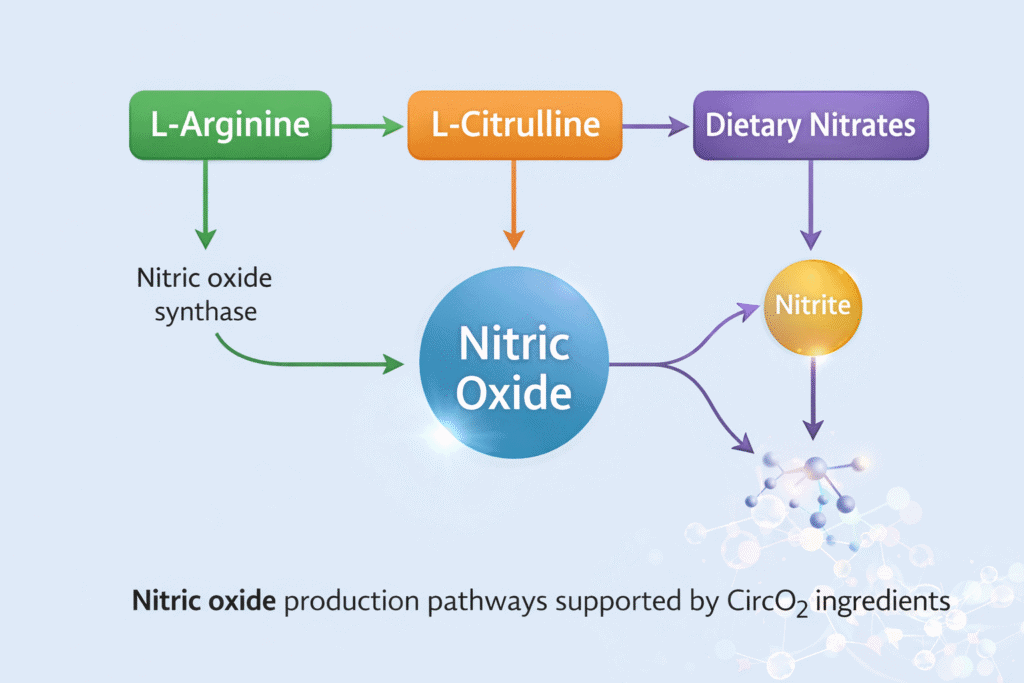
Rather than relying on a single mechanism, the ingredients in CircO2 are structured to support nitric oxide availability through multiple, complementary physiological pathways. Readers who want a deeper explanation of these biological mechanisms can explore how CircO2 works within the body’s nitric oxide pathways.
L-Arginine provides a direct substrate for nitric oxide synthesis, while L-Citrulline helps sustain arginine levels over time by supporting its natural recycling process. Together, these amino acids contribute to both immediate and more sustained nitric oxide production.
Beetroot extract introduces dietary nitrates, which follow an alternative nitrate–nitrite–NO pathway that can function independently of nitric oxide synthase enzymes. This broadens the ways nitric oxide may be generated within the body.
Vitamin C supports this system by helping protect nitric oxide from oxidative stress and supporting endothelial health, which is essential for proper vascular responsiveness.
By combining these ingredients, CircO2 aims to support nitric oxide balance through interconnected biological processes rather than isolated or short-term effects.
For readers interested in understanding how these ingredients fit into the overall circulation support strategy of CircO2, the complete product review explains the full formulation in greater detail.
Ingredient Quality and Manufacturing Considerations

When evaluating any supplement formula, ingredient quality and manufacturing standards are important considerations alongside the ingredient list itself. Readers interested in understanding potential reactions or safety considerations may also explore the possible side effects associated with CircO2 supplementation. Factors such as sourcing, purity, and processing methods can influence consistency and reliability.
Amino acids and plant extracts used in nitric oxide formulations are typically produced under controlled conditions to support stability and accurate dosing. Manufacturing practices that follow Good Manufacturing Practices (GMP) guidelines help support quality control, proper labeling, and batch consistency.
While manufacturing standards do not guarantee effectiveness, they provide an important framework for safety and product reliability.
Final Ingredient Overview
The ingredient profile of CircO2 reflects a focused approach to nitric oxide support, emphasizing compounds that are well understood within human physiology. Rather than introducing experimental substances, the formula relies on ingredients commonly studied in relation to circulation and vascular function.
By combining amino acids involved in nitric oxide synthesis with dietary nitrates and antioxidant support, CircO2 addresses nitric oxide availability through multiple complementary pathways. These mechanisms are associated with the circulation support benefits CircO2 is designed to provide. This structure aligns with how nitric oxide is naturally regulated in the body.
As with any dietary supplement, individual responses may vary based on age, lifestyle, and overall health status. For guidance on responsible use, readers may review the recommended CircO2 dosage and usage guidelines. CircO2 is best viewed as a supportive tool rather than a standalone solution within a broader circulation and cardiovascular wellness strategy. Individuals wondering whether this type of supplement may fit their routine can explore who CircO2 may be designed for.
Readers who prefer to review the official product information directly — including the manufacturer’s ingredient list, usage instructions, and current availability — can visit the official CircO2 website.
For a broader evaluation of how this ingredient profile fits into the overall formula, including safety considerations and practical use, refer to the CircO2 Nitric Oxide Review. Readers interested in evaluating the broader evidence and expectations surrounding the formula may also explore whether CircO2 really works according to available information.
Medical Disclaimer
The information provided in this article is for educational and informational purposes only and is not intended as medical advice.
Dietary supplements are not intended to diagnose, treat, cure, or prevent any disease. Individual responses to supplements may vary based on health status, lifestyle, and other factors.
Before starting any new supplement, including CircO2, consult with a qualified healthcare professional, especially if you have a medical condition, are pregnant or nursing, or are taking prescription medications.